
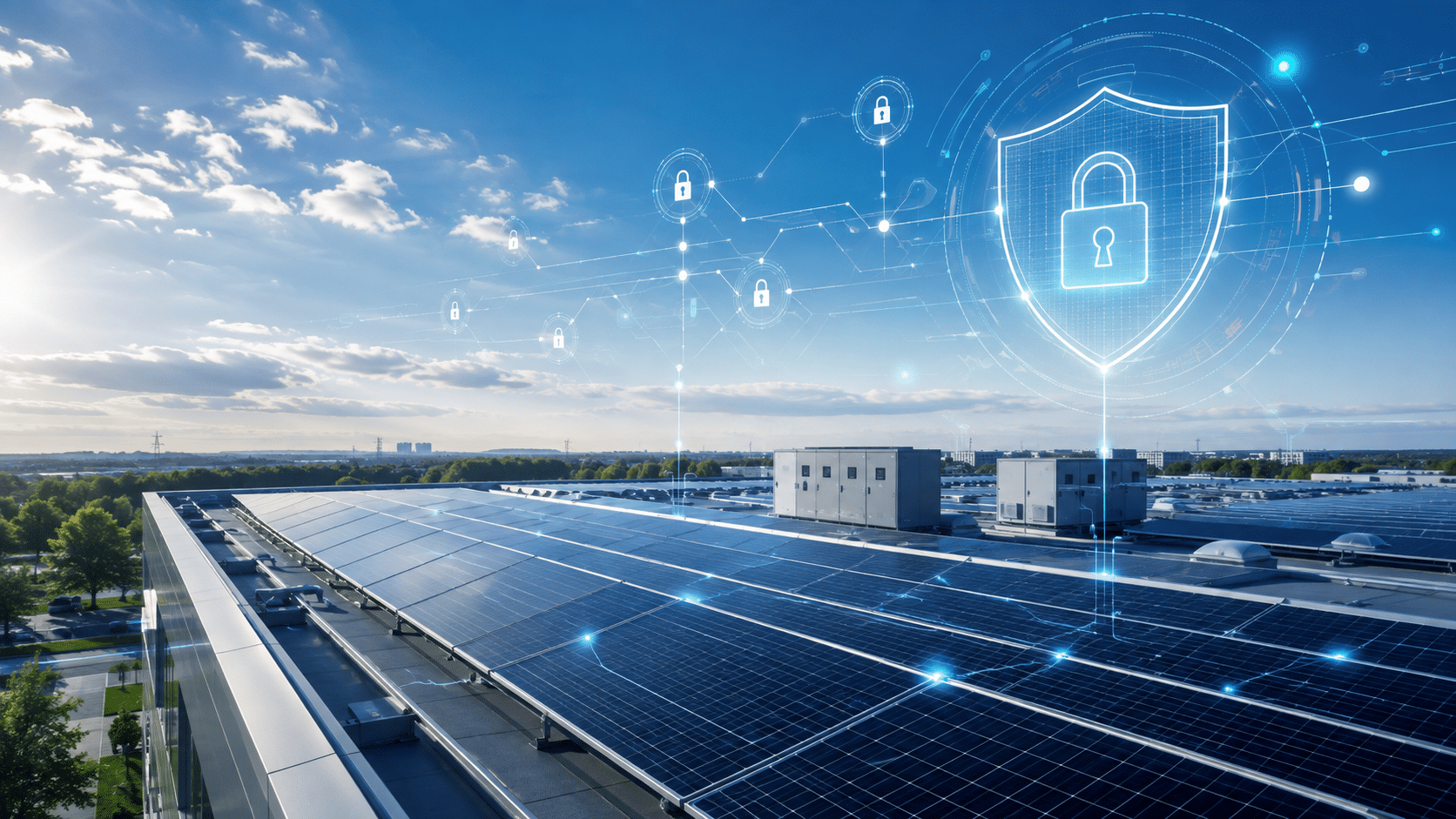
The next commercial solar performance problem may not begin with a failed inverter, damaged conductor, or severe weather event. It may begin with an old password.
Modern solar assets are connected operating environments. Inverters, data acquisition systems, SCADA gateways, cellular modems, cloud dashboards, APIs, and mobile applications continuously exchange information. Those connections provide valuable visibility and faster service—but they also create access pathways that must be deliberately managed.
For executives, this is not simply an IT concern. It is an asset-control, business-continuity, and investment-protection concern. If no one can identify who holds administrator privileges, which vendors retain remote access, who manages firmware updates, or how an unauthorized change would be detected, the organization may not have full operational control of its solar investment.
The Solar Energy Industries Association’s 2026 cybersecurity report notes that many distributed solar and storage systems depend on internet connections for monitoring and control. It also highlights the many owners, operators, EPCs, vendors, and third parties that may share responsibility—and the difficulty of embedding cybersecurity into engineering, operations, and maintenance. Cybersecurity therefore belongs within the commercial solar O&M conversation, not as a replacement for corporate IT, but as a coordinated operational discipline.
Commercial Solar Has a Digital Control Plane
Solar arrays are physical infrastructure, but their performance increasingly depends on a digital control plane. Monitoring platforms collect production data. Gateways transmit alarms. Inverter firmware governs equipment behavior. Remote accounts allow vendors to troubleshoot equipment. Energy-management systems may coordinate solar, storage, facility loads, and utility requirements.
The National Institute of Standards and Technology defines operational technology as programmable systems and devices that interact with the physical environment. The U.S. Department of Energy emphasizes that energy-sector cyber risk extends beyond software to hardware, firmware, services, installation, configuration, operation, and maintenance. A compromised operational pathway can therefore affect equipment settings, system visibility, availability, and physical processes.
Many commercial systems fall outside the mandatory cybersecurity requirements applied to large bulk-power assets, yet still contain internet-connected devices and third-party service pathways. The exposure is not always a sophisticated attack. It may be a default credential, a former employee whose access was never removed, an installer account shared across projects, unsupported firmware, or a portal nobody actively governs.

The Business Risk Is Operational, Not Abstract
Executives responsible for commercial solar assets should focus on the business consequences.
Loss of visibility. If monitoring data becomes unavailable or unreliable, operators may miss alarms and fail to recognize underperformance.
Unauthorized or undocumented changes. Poorly governed remote access may allow settings to be changed without approval, documentation, or verification.
Longer downtime. Recovery slows when no one knows who owns the master account, which firmware is installed, whether configurations were backed up, or how the site communicates.
Reporting exposure. Owners rely on production data for financial reporting, sustainability metrics, performance guarantees, warranties, and forecasting. A data-integrity problem can become an executive reporting problem.
Third-party dependence. Solar operations often involve the owner, corporate IT, the EPC, OEMs, telecom providers, monitoring vendors, and O&M contractors. When responsibilities are assumed rather than documented, critical tasks can fall between organizations.
Recent CISA advisories demonstrate why these concerns are practical. Disclosed vulnerabilities in solar monitoring and gateway products included the potential for unauthorized administrative access, exposure of plant information, modification of settings, and disruption of solar production. These advisories do not mean every connected asset is under attack. They do show that monitoring and remote-control infrastructure should be treated as part of the asset—not as an invisible convenience.
The Most Vulnerable Moment May Be the Handoff
Commercial solar systems accumulate access over time. The EPC creates accounts during construction. Commissioning agents and OEM technicians receive credentials. Monitoring providers establish integrations. Facility personnel change roles. O&M contracts transition. Companies acquire or sell sites.
Unless access is reconciled at each transition, the owner may inherit a system with unclear digital custody.
A disciplined handoff should establish an owner-controlled inventory of connected devices, portals, account owners, permission levels, remote-access methods, firmware versions, configuration backups, vendor contacts, and escalation procedures.
This is where Pre-Construction & Owner Advisory Consulting and Commissioning Support can create long-term value. Access ownership, maintainability, documentation, and vendor responsibilities should be addressed before turnover—not discovered during an outage.

Cybersecurity Is a Shared Operational Responsibility
No single party can secure a commercial solar system alone.
Corporate IT typically governs identity, network architecture, remote-access policy, and incident response. Equipment manufacturers manage product vulnerabilities and firmware. Asset owners define priorities and contractual accountability. O&M teams understand field devices, normal operating behavior, service pathways, and the physical consequences of communications or control failures.
The owner should define who is accountable for:
- Approving and revoking user and vendor access
- Maintaining device and account inventories
- Reviewing firmware and vulnerability notices
- Backing up configurations and documenting changes
- Monitoring communications health and unusual behavior
- Escalating incidents and coordinating safe recovery
An O&M provider should not replace a cybersecurity specialist. It should serve as the operational bridge between the people securing the network and the people responsible for energy production.

An Executive Checklist for Connected Solar Assets
Commercial solar leaders do not need to become cybersecurity engineers. They do need to ask the right governance questions.
- Do we have a complete connected-asset inventory? Document inverters, gateways, DAS and SCADA components, modems, cloud portals, APIs, and applications.
- Does the owner control the primary accounts? Master credentials should not exist solely with an installer, former employee, or vendor.
- Are privileges current? Remove dormant users, eliminate shared and default credentials, apply role-based permissions, and use multifactor authentication where supported.
- Is remote vendor access governed? Define who may connect, through what method, for what purpose, for how long, and with what documentation.
- Is there a firmware and vulnerability process? Assign responsibility for notices, impact review, updates, and completed-work records.
- Are configurations backed up and changes controlled? Preserve critical settings so systems can be restored after replacement, error, or incident.
- Can monitoring trigger action? Data gaps, communications failures, abnormal alarms, and unexplained changes need defined escalation paths.
- Is incident response coordinated with field operations? Recovery may require equipment isolation, onsite verification, controlled re-energization, and confirmation that production data is accurate.
Turning Cyber Awareness Into Operational Discipline
Servist Energy’s full-lifecycle Solar O&M Services help commercial owners bring structure, documentation, and accountability to the systems behind solar performance.
Through Monitoring & Performance Reporting, Servist helps owners maintain visibility into system health, communications, alarms, and production trends. Preventive Maintenance and Advanced Testing & Diagnostics connect digital observations to field-verified conditions, helping determine whether an anomaly originates in equipment, communications, configuration, or site conditions. When failures occur, Corrective Repairs & Support provides a structured path from diagnosis through documented restoration.
This coordination matters because cybersecurity and reliability increasingly overlap. A communications failure may resemble an inverter failure. A data problem may conceal a production problem. A poorly documented configuration change may complicate troubleshooting. The answer is not more technology alone—it is disciplined coordination among asset owners, IT teams, equipment vendors, and experienced solar operations professionals.

Conclusion: Control the Access to Protect the Asset
The question is no longer whether a commercial solar system is connected. The question is whether those connections are known, controlled, documented, and actively governed.
Executives who treat access management, monitoring integrity, firmware responsibility, and incident coordination as part of O&M are better positioned to protect uptime, reporting confidence, and long-term asset value. The first step is straightforward: determine who still has the keys—and make sure the owner remains in control.
References
- Solar Energy Industries Association (SEIA) — Cybersecurity Priorities for America’s Solar & Storage Industry — https://seia.org/research-resources/cybersecurity-priorities-for-americas-solar-storage-industry/
- Solar Energy Industries Association (SEIA) — Inverter & Supply Chain Cybersecurity — https://seia.org/research-resources/inverter-supply-chain-cybersecurity/
- U.S. Department of Energy, Office of Cybersecurity, Energy Security, and Emergency Response — CESER Secures Critical Infrastructure Through Cyber Supply Chain Risk Management — https://www.energy.gov/ceser/articles/ceser-secures-critical-infrastructure-through-cyber-supply-chain-risk-management
- U.S. Department of Energy, Solar Energy Technologies Office — Solar Cybersecurity — https://www.energy.gov/cmei/systems/solar-cybersecurity
- National Institute of Standards and Technology (NIST) — Guide to Operational Technology (OT) Security, NIST SP 800-82 Rev. 3 — https://csrc.nist.gov/pubs/sp/800/82/r3/final
- Cybersecurity and Infrastructure Security Agency (CISA) — Tigo Energy Cloud Connect Advanced (Update A) — https://www.cisa.gov/news-events/ics-advisories/icsa-25-217-02
- Cybersecurity and Infrastructure Security Agency (CISA) — SolisCloud Monitoring Platform — https://www.cisa.gov/news-events/ics-advisories/icsa-25-338-06
About the Author - Jesse Waters
About the Author — Jesse Waters
Jesse Waters is the Founder and CEO of Servist Energy, a rapidly growing operations and maintenance (O&M) firm specializing in commercial and utility-scale solar and energy storage systems. With a background rooted in field service, workforce development, and asset-management strategy, Jesse has built his career around one principle: great energy assets are only as strong as the people who maintain them.
He is passionate about elevating the skilled workforce, modernizing O&M, and driving the renewable-energy transition through world-class service, operational excellence, and technician empowerment. Jesse writes and speaks on topics such as workforce shortages, reliability in renewables, field innovation, and the future of U.S. energy infrastructure.
About Servist Energy
Servist Energy provides mission-critical operations, maintenance, and technical services for commercial and utility-scale solar and storage assets across the Mid-Atlantic and Northeast. We help asset owners, EPCs, developers, and investors protect system performance, reduce downtime, and extend the life of their renewable assets.
Our philosophy is simple: People. Process. Performance.
By investing in elite technicians, modern tools, and strict service standards, we deliver the reliability, transparency, and responsiveness the industry has been missing. From preventative maintenance and corrective repairs to advanced diagnostics and commissioning support, Servist ensures that every asset we touch performs at its fullest potential — day after day, year after year.