
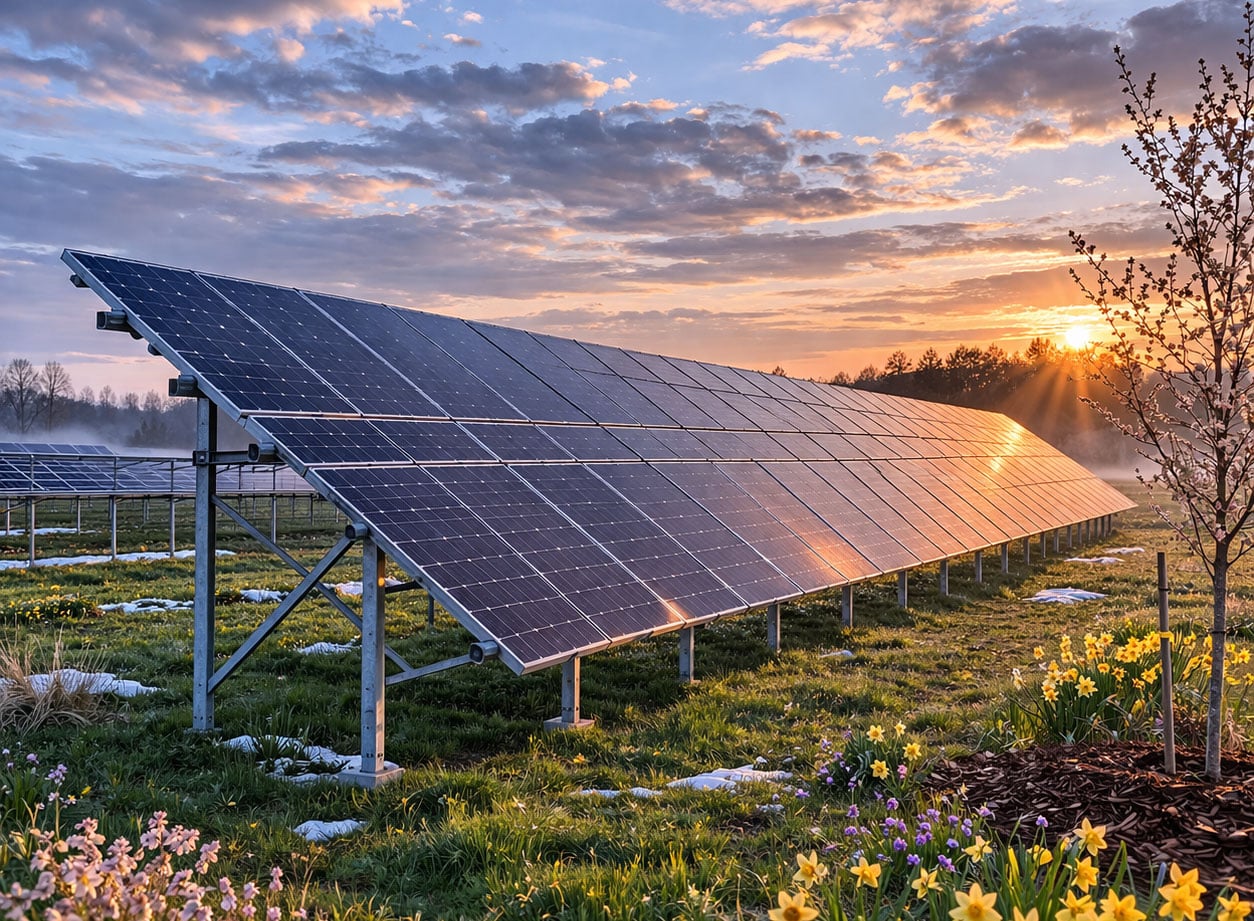
Spring Is Not a Reset—It’s a Reveal
For commercial solar asset owners and portfolio managers, spring is often misinterpreted as the natural start of strong performance. Longer days, stronger irradiance, and rising production curves create the illusion that systems will simply “bounce back” after winter.
But in reality, spring doesn’t improve performance. It reveals it.
After months of winter stress—thermal cycling, moisture exposure, limited access, and operational constraints—solar systems enter spring carrying the cumulative effects of everything that was maintained, overlooked, or deferred.
Spring is not a beginning.
It is a conversion point—where preparation becomes performance, or neglect becomes measurable loss.
For executives responsible for solar investments, this moment is critical:
Peak production isn’t achieved in summer—it’s secured in spring.

The Post-Winter Reality: Hidden Risk Beneath Rising Irradiance
Winter rarely causes immediate, catastrophic failure. Instead, it introduces small, compounding issues:
- Electrical connections loosen from expansion and contraction
- Moisture intrudes into enclosures and connectors
- Inverter components experience stress during cold starts
- Debris accumulates, reducing irradiance capture
- Monitoring systems drift or lose accuracy
Industry reporting across PV Magazine, Utility Dive, and Solar Industry Magazine consistently shows that many performance losses stem from unresolved minor issues—not major failures.
These issues often remain invisible—until spring.
As irradiance increases, so does system sensitivity. What was once negligible becomes measurable:
- A loose connection becomes resistive loss
- Soiling becomes reduced energy yield
- Faulty data becomes delayed response
Spring exposes inefficiencies at the exact moment performance expectations rise.
Why Spring Is the Highest-Leverage Performance Window
Spring represents the most important operational window in the solar calendar—not because of weather, but because of timing.
- Irradiance increases rapidly
- Production hours extend
- Revenue potential accelerates
According to insights from SEIA, PV-Tech, and Canary Media, small inefficiencies can translate into significant financial impact during peak months.
Consider this:
- A 5% inefficiency in winter → minimal financial impact
- A 5% inefficiency in summer → substantial revenue loss
That inefficiency doesn’t change—but its impact does.
This is why spring matters.
It is the final opportunity to identify and eliminate inefficiencies before they scale into peak-season losses.

Priority #1: Restore Mechanical & Electrical Integrity
The first step in spring optimization is stabilization.
Winter conditions stress every component in a system. Without intervention, those stress points evolve into failures under higher production loads.
Key actions include:
- Torque verification across all electrical terminations
- Inspection of wiring, conduit, and insulation integrity
- Grounding system validation
- Inverter inspections (cooling systems, seals, capacitors, connections)
Research from Solar Power World and Utility Dive confirms that preventive maintenance significantly reduces failure rates and improves uptime across commercial systems.
Servist Energy’s Preventive Maintenance and Corrective Repairs & Support services are designed to address these risks proactively—ensuring systems enter peak season stable, compliant, and ready.
Because failures during peak production aren’t just operational issues—they’re revenue events.
Priority #2: Maximize Energy Capture Through Cleaning & Shading Mitigation
Even high-performing systems can underdeliver if they are not clean and unobstructed.
Data from PV Magazine USA and Renewable Energy World shows:
- Soiling losses commonly range from 5% to 15%
- In more severe conditions, losses can exceed 25%
Spring introduces additional variables:
- Pollen buildup
- Residual winter debris
- Dust and environmental particulates
- Vegetation regrowth impacting shading patterns
These factors directly reduce irradiance capture—precisely when solar input is increasing.
Key actions include:
- Professional panel cleaning
- Vegetation trimming and shading analysis
- Seasonal obstruction assessments
Servist Energy integrates these capabilities within its Preventive Maintenance programs, ensuring maximum sunlight conversion during peak months.
Recovered sunlight equals recovered revenue.

Priority #3: Validate Monitoring & Performance Accuracy
Modern solar performance is driven as much by data as it is by hardware.
Monitoring systems enable visibility, diagnostics, and decision-making. But when data is inaccurate or delayed, even well-maintained systems can underperform.
Insights from PV-Tech, EnergyTrend, and Canary Media highlight that:
Actively monitored systems outperform unmanaged assets due to faster detection and response times.
Spring readiness requires:
- Sensor calibration
- Communication system verification
- Alarm validation and response testing
- Data accuracy audits across SCADA systems
Without these steps, issues can persist undetected—eroding performance throughout peak season.
Servist Energy’s Monitoring & Performance Reporting services ensure real-time visibility, accurate analytics, and proactive issue identification.
Because in solar operations, you can’t fix what you can’t see—and you can’t trust what you can’t measure.
Priority #4: Deploy Advanced Diagnostics Before Peak Load
Some of the most impactful performance issues are not visible during routine inspections.
They require advanced diagnostic tools to identify:
- Microcracks within modules
- Hotspots and resistive heating
- String-level imbalances
- Insulation degradation
Industry sources such as PV Magazine and Solar Business Hub emphasize that advanced diagnostics are essential for identifying hidden performance risks before they escalate.
Key technologies include:
- Thermal imaging (IR scans)
- IV curve tracing
- Insulation resistance testing
Servist Energy’s Advanced Testing & Diagnostics services provide deep system visibility—allowing asset owners to detect and resolve issues before they impact peak production.
Diagnostics turn hidden risk into actionable intelligence.

Priority #5: Eliminate Backlog Before It Becomes Downtime
Deferred maintenance is one of the most common—and costly—risks in commercial solar.
Common backlog items include:
- Minor inverter faults
- Degraded connectors and wiring
- Underperforming modules
- Communication system inconsistencies
According to Utility Dive and Solar Industry Magazine, delaying repairs increases both the likelihood and cost of future failures.
Spring is the final window to address these issues efficiently.
Once peak season begins:
- System load increases
- Downtime becomes more expensive
- Access and repair windows become more constrained
Servist Energy’s Corrective Repairs & Support services are designed to eliminate these risks before they scale.
Spring as a Strategic Event: The Recommissioning Mindset
Leading asset managers are shifting their approach to spring.
Instead of treating it as a passive transition, they treat it as a planned operational event—a system-wide recommissioning phase.
This includes:
- Cleaning
- Mechanical and electrical inspections
- Monitoring validation
- Advanced diagnostics
- Targeted repairs
Industry best practices highlighted by PV-Tech and broader O&M leaders show that bundled, seasonal maintenance strategies deliver stronger long-term system performance.
Servist Energy’s integrated O&M model aligns directly with this approach—ensuring every aspect of system performance is addressed cohesively.

The Financial Perspective: Turning Readiness Into Revenue
For executives, the value of spring readiness is not theoretical—it is measurable.
Effective spring O&M delivers:
- Increased uptime
- Higher energy yield
- Reduced emergency repair costs
- Extended asset lifespan
- Improved long-term ROI
This is not maintenance as an expense.
It is maintenance as revenue protection—and revenue acceleration.
Because peak production isn’t just about sunlight.
It’s about whether your system is prepared to convert that sunlight into consistent, optimized performance.
Conclusion: Peak Output Is Engineered—Not Seasonal
Spring does not guarantee performance. It reveals it.
The systems that perform at the highest level in summer are not the ones that simply survived winter—they are the ones that were inspected, corrected, validated, and optimized in spring.
That is the difference between:
- Assets that accelerate
- And assets that carry hidden drag
Servist Energy’s full-service O&M ecosystem—Preventive Maintenance, Monitoring & Performance Reporting, Corrective Repairs & Support, and Advanced Testing & Diagnostics—ensures that no inefficiency enters peak season unnoticed.
Because in commercial solar:
Peak output isn’t seasonal—it’s engineered.
References
- PV Magazine USA – The impact of soiling on solar panel performance
https://www.pv-magazine-usa.com - Solar Power World – Why solar preventive maintenance is critical for system performance
https://www.solarpowerworldonline.com - Utility Dive – How proactive maintenance is reshaping solar asset management
https://www.utilitydive.com - Renewable Energy World – Seasonal impacts on solar system output and efficiency
https://www.renewableenergyworld.com - PV-Tech – Best practices in solar O&M and monitoring performance optimization
https://www.pv-tech.org - Canary Media – The role of analytics in improving renewable energy performance
https://www.canarymedia.com - Solar Industry Magazine – The cost of deferred maintenance in solar energy systems
https://www.solarindustrymag.com - Solar Business Hub – Advanced diagnostics and testing for PV system performance
https://solarbusinesshub.com - SEIA – Solar performance and operational best practices
https://www.seia.org/news - EnergyTrend – Monitoring and analytics trends in solar energy systems
https://www.energytrend.com
About the Author - Jesse Waters
About the Author — Jesse Waters
Jesse Waters is the Founder and CEO of Servist Energy, a rapidly growing operations and maintenance (O&M) firm specializing in commercial and utility-scale solar and energy storage systems. With a background rooted in field service, workforce development, and asset-management strategy, Jesse has built his career around one principle: great energy assets are only as strong as the people who maintain them.
He is passionate about elevating the skilled workforce, modernizing O&M, and driving the renewable-energy transition through world-class service, operational excellence, and technician empowerment. Jesse writes and speaks on topics such as workforce shortages, reliability in renewables, field innovation, and the future of U.S. energy infrastructure.
About Servist Energy
Servist Energy provides mission-critical operations, maintenance, and technical services for commercial and utility-scale solar and storage assets across the Mid-Atlantic and Northeast. We help asset owners, EPCs, developers, and investors protect system performance, reduce downtime, and extend the life of their renewable assets.
Our philosophy is simple: People. Process. Performance.
By investing in elite technicians, modern tools, and strict service standards, we deliver the reliability, transparency, and responsiveness the industry has been missing. From preventative maintenance and corrective repairs to advanced diagnostics and commissioning support, Servist ensures that every asset we touch performs at its fullest potential — day after day, year after year.